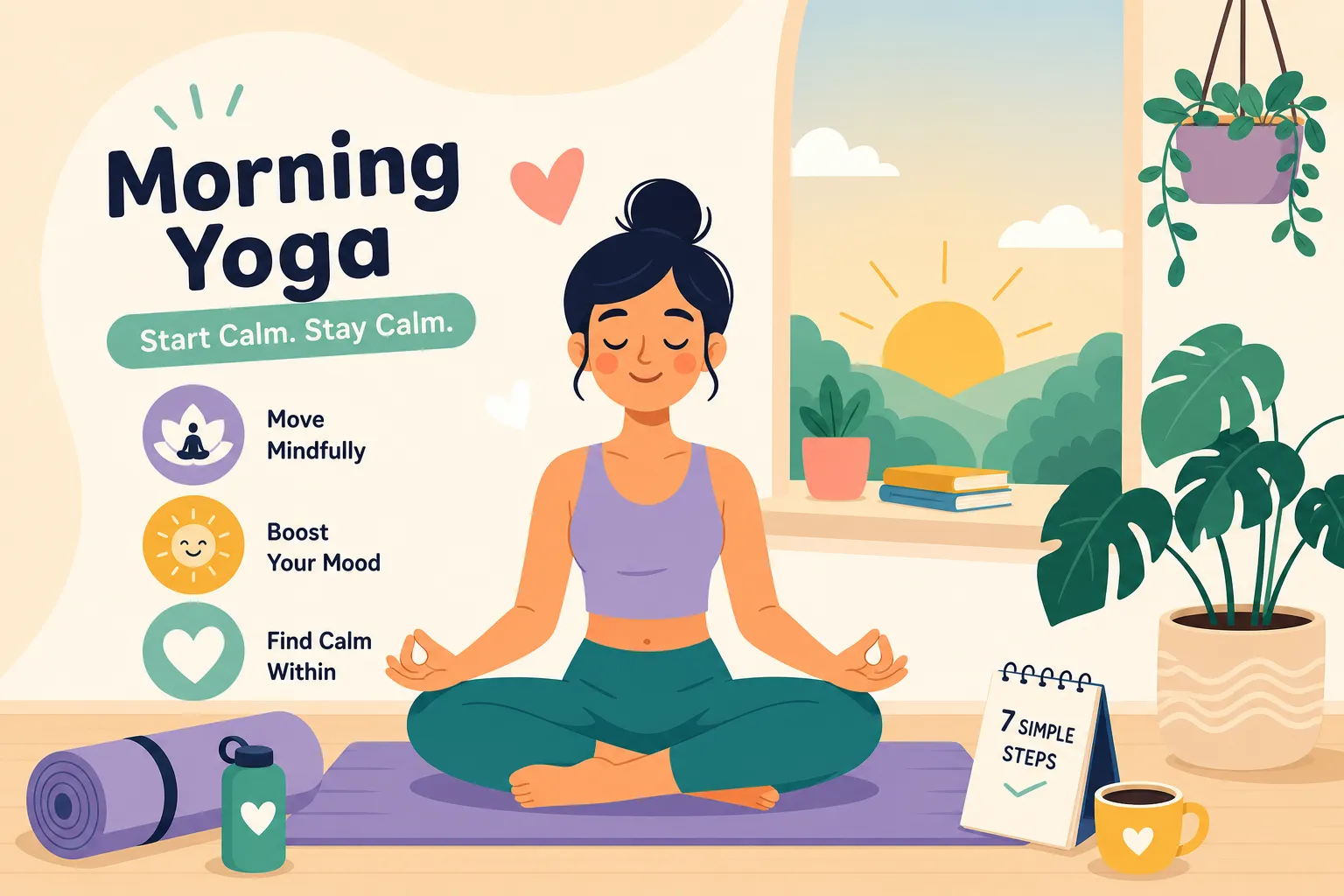
How to build a calming morning yoga habit is a question most people answer the wrong way. They set the alarm for 6 a.m., attempt a 30-minute flow, and by day three, the mat is back in the cupboard. Most morning yoga habits don’t die from laziness, they die from ambition. The problem isn’t motivation. It’s the starting point.
Building a calming morning yoga practice is less about willpower and more about structure. A simple, progressive plan is the difference between a two-day streak and a two-year practice. If you’ve ever wanted a beginner-friendly place to start, platforms like Activrr exist for exactly this reason. Here are the seven steps that make it work.
Why most morning yoga routines quietly disappear
Two things kill yoga habits early: starting with an unrealistic duration and having no clear trigger to tell your brain it’s yoga time. Habit researchers have found that health-related habits take closer to two to five months to feel automatic, not the oft-cited 21 days. If your practice doesn’t feel effortless after two weeks, you haven’t failed. You’re simply still in the learning phase.
Why “all or nothing” is the habit killer
Starting with a full 20-minute practice creates a psychological trap. On a rushed morning, 20 minutes feels impossible, so you skip entirely. A 5-minute practice, on the other hand, is far easier to sustain, short practices significantly reduce the friction that causes people to abandon new habits altogether. In the first two weeks, the goal isn’t transformation. It’s just showing up.
The missing trigger most beginners overlook
A trigger is simply something you already do every morning that yoga can follow. Brushing your teeth, making coffee, getting out of bed: these are your natural anchors. Without one, the habit floats loose and gets pushed out by the day before you’ve even noticed it’s gone.
How to build a calming morning yoga habit: Steps 1 to 3
These three steps happen before you even unroll the mat. They remove the small frictions that cause people to skip. None of them require motivation, only a little preparation.
Step 1. Pick one cue and stick with it
Attach yoga to something that already happens every morning. “After I brush my teeth, I unroll my mat” is more powerful than “I’ll do yoga in the morning.” The specificity of the cue is what makes the habit automatic over time. Vague intentions don’t survive chaotic mornings. Specific ones often do. For busy schedules, exploring methods like habit stacking for busy professionals can make choosing and sticking to a single cue much easier.
Step 2. Set up your space the night before
A mat left rolled up in a cupboard creates a small but real barrier. A mat already unrolled in a clear corner removes one decision from a tired morning brain. Set your water bottle beside it the night before. Reducing morning decisions protects the habit, research on friction and preparatory behaviour consistently shows that lowering the effort required the evening before improves follow-through the next day.
Step 3. Start with exactly 5 minutes
Five minutes is not a warm-up. For week one, it is the whole session. A simple sequence that works well for beginners: Easy Pose with slow breathing (1 minute), Cat-Cow (1 minute), Child’s Pose (1 minute), Low Lunge on both sides (1 minute), and Corpse Pose (1 minute). Four beginner-friendly movements and short, repeatable sequences often outlast ambitious, complicated routines. Research into breathwork and slow movement suggests the nervous system responds to long exhales and gentle movement rather than duration alone, though gradually increasing time over weeks still matters for building a fuller practice.
How to build a calming morning yoga habit: The 4-week plan and breathwork
This is where consistency compounds into an actual habit. The progression is gentle by design: Week 1 is 5 minutes daily, building the cue-routine loop. Week 2 adds 1 minute of breathing on three days per week. Week 3 extends to 7 to 8 minutes on most days, with two lighter days for recovery. Week 4 reaches 10 minutes on weekdays, with 5-minute reset sessions on the weekend.
Step 4. Grow slowly with a 4-week progression
The week, not the day, is your unit of measurement. Alternate stronger mornings with gentler ones rather than trying to match the same intensity every day. If designing this progression feels like yet another task on your list, Activrr’s beginner morning yoga classes offer a ready-made structure with a wide library of guided sessions; for sample sequences and routines, consult a morning yoga routine guide to see how short sessions can be arranged into a gentle progression.
Step 5. Close every session with 2 minutes of breathing
Box breathing is the simplest tool here: inhale for 4 counts, hold for 4, exhale for 4, hold for 4. Even two minutes of this after the physical practice supports a shift towards a calmer, more settled state, open-access studies and clinical reports on structured breathwork show short-term reductions in stress and increased parasympathetic activity. For practical guides, try a quick morning breathing exercises routine or a step-by-step breathwork tutorial video when you’re learning the timing. Clinical research on the effect of breathing exercise on stress hormones supports the physiological benefits of this short finish, and resources that explain how poses calm the nervous system can help you pair posture and breath for maximum effect. If you prefer a straightforward read about breath techniques, see these four breathing techniques for better health as another practical reference.
Steps 6 and 7: Staying on the mat when mornings go sideways
Some mornings are genuinely chaotic. The goal isn’t perfection, it’s pattern. These two steps keep that pattern alive when life interrupts it.
Step 6. Never miss twice in a row
Missing one day is a rest. Missing two days in a row, however, is where habits tend to unravel. The rule is straightforward: return the very next morning, even if it’s just 5 minutes. Habit experts who write about how to make exercise a daily habit recommend restarting promptly rather than trying to compensate for missed sessions, as the cue-routine connection weakens with each consecutive gap. For context on how long habit formation often takes and why patience matters, see this overview on how long it takes to form a habit.
Step 7. Have a 2-minute fallback for impossible mornings
On mornings with zero time, two minutes of Cat-Cow and Child’s Pose with slow exhales still counts as a short morning yoga session. The point isn’t the physical benefit of two minutes, it’s keeping the cue-routine connection alive in the brain. For simple poses to rely on when time is scarce, consult a short list of the best yoga poses for beginners and pick two that feel restorative. If you want a quick look at common pitfalls to avoid as a beginner, this piece on why beginners quit yoga is a useful reality check that reinforces the “keep it tiny” approach.
You don’t need a perfect morning. You need a repeatable one.
If you’ve been wondering how to build a calming morning yoga habit, these seven steps give you a complete answer: one cue, a prepared space, a 5-minute start, a 4-week progression, closing breathwork, the never-miss-twice rule, and a 2-minute fallback for difficult mornings. Consistency, as habit research repeatedly confirms, outperforms ambition at every stage. For practical perspectives on sticking to the small daily choices that build routines, see this guide on how to stick to a morning routine.
For readers who want a guided starting point rather than a blank mat, Activrr’s beginner morning yoga classes offer exactly the structure this plan describes: progressive, calm, and built for real mornings, not ideal ones. If you’d like to read a first-person account of small daily practice, this trial of doing yoga every morning for two weeks shows how modest, consistent practice changes perception. Start with five minutes tomorrow, the mat is already waiting.
If you want a quick primer on how movement reduces stress outside of formal practice, this overview of yoga for stress relief highlights why short, targeted sessions can move the needle on tension and mood. With a tiny, repeatable plan and the resources above, a calming morning yoga habit becomes not a test of willpower but a small, reliable daily pattern that reshapes your mornings over weeks and months.