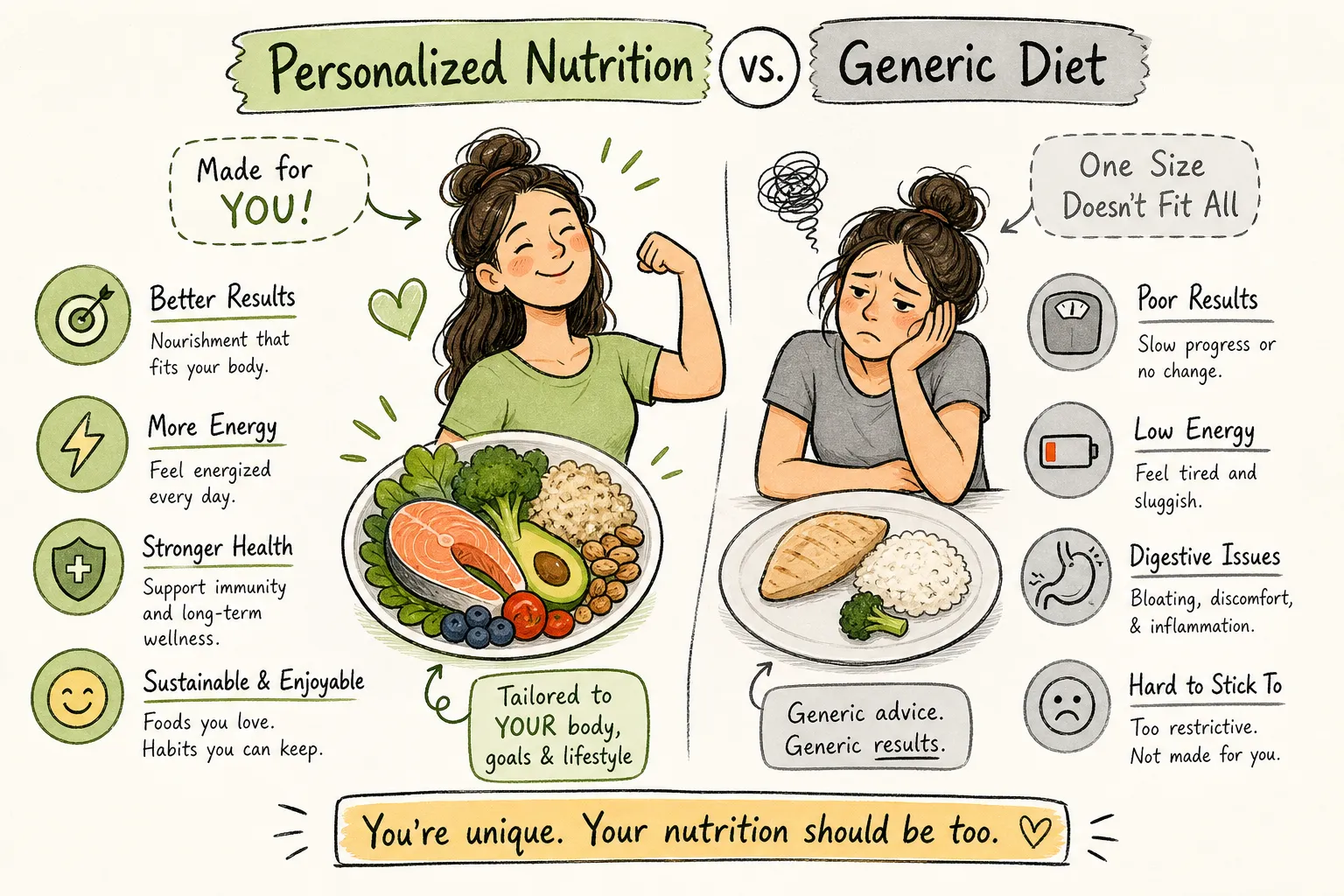
What are the main benefits of personalized nutrition compared to a generic diet? Two people follow the exact same diet for 12 weeks. One loses weight. The other doesn’t. Most people assume the second person failed somehow. The more honest explanation: the diet failed them.
Generic diets are built on population averages. They don’t account for the person eating them. That gap, between average advice and individual biology, is why so many people do everything by the book and still don’t see results. This article breaks down what the research actually shows about personalized nutrition versus a generic diet, what makes it different in practice, and who benefits most from it. For individuals dealing with conditions like thyroid disorders or PCOS, or simply eating within an Indian food culture that most nutrition plans never consider, generic advice has a structural ceiling that a personalized diet is built to overcome.
Why the same diet doesn’t work the same way for two people
Your metabolism, hormones, and gut aren’t standard issue
Two people eating identical calories and identical macros will have different blood glucose responses, different fat storage patterns, and different energy levels. That’s not speculation. It’s what repeated nutrition research has demonstrated consistently. Your metabolic rate, insulin sensitivity, and hormonal profile create nutritional requirements that no population average can predict accurately.
Hormonal conditions like hypothyroidism and PCOS compound this further. In PCOS, insulin resistance makes the body less tolerant of refined carbohydrate loads. In hypothyroidism, the metabolic rate slows, and severe caloric restriction can backfire by elevating cortisol and impairing thyroid hormone conversion. A plan built without accounting for either condition isn’t just suboptimal. It’s working against the person following it.
What real-world comparisons reveal about personalized nutrition vs a generic diet
The Food4Me trial, conducted across seven European countries with 1,269 adults, found that participants receiving personalized nutrition advice made more sustained dietary improvements than those on conventional guidance. They consumed less red meat, less salt, less saturated fat, and scored higher on the Healthy Eating Index at six months. That’s a meaningful, practical difference in real eating behavior.
A useful illustration: an Indian professional eating “healthy” by general standards may be over-relying on refined carbohydrates common in a traditional diet. A standard Western nutrition plan often does not flag that as a problem. A personalized one will. The difference isn’t about discipline. It’s about whether the plan was designed for the actual person.
What are the main benefits of personalized nutrition compared to a generic diet?
The metabolic wins that show up consistently
The 2024 ZOE METHOD trial, published in Nature Medicine, randomized 347 adults to an 18-week personalized nutrition program or standard dietary guidance. The personalized group showed greater weight loss, greater triglyceride reduction, and greater HbA1c improvement. LDL cholesterol did not change significantly overall, and that’s worth noting honestly. A 2025 meta-analysis in Nutrition Reviews also found better blood pressure outcomes with personalized interventions compared to usual care. These are meaningful advantages, not sweeping ones.
For people with metabolic conditions, the benefits are often sharper. Studies in prediabetes and metabolic syndrome populations show that precision approaches targeting postprandial glucose, waist circumference, and insulin sensitivity frequently outperform generic advice. The long-term evidence is still building, but the direction across studies is consistent.
Where personalized nutrition wins most reliably: adherence
Across studies, the most consistent finding isn’t dramatic clinical results. It’s that people actually follow personalized plans. In one published systems nutrition trial, compliance with personalized meal plans reached 82%. Food4Me participants maintained healthier eating patterns at the six-month follow-up. Compare that with the well-documented reality of generic diets: some research estimates that a large majority of people regain lost weight after completing a standard plan, a pattern attributed largely to plans that don’t fit real-life eating habits.
A plan you follow beats a perfect plan you abandon. Adherence is the mechanism behind every other benefit. When advice is relevant to your actual food habits, your health history, and your daily schedule, it becomes something you can realistically sustain. A one-size-fits-all diet rarely achieves that.
The individual factors that change what you actually need to eat
Hormonal health, food intolerances, gut microbiome, and metabolic conditions
Gut microbiome differences add another layer most generic plans never address. Research shows that individual microbiome activity helps predict post-meal glucose responses. Two people eating the same meal can have meaningfully different blood sugar spikes because their gut bacteria are doing different biochemical work. They produce different short-chain fatty acids, different incretin signals, and different effects on insulin sensitivity. This microbiome-based diet response isn’t a fringe finding. It’s well-documented at the mechanistic level.
Food intolerances and individual nutrient absorption rates also vary considerably. Personalized approaches that account for phenotype, biomarkers, and existing conditions often show stronger outcomes than generic advice for people with hormonal or metabolic challenges, particularly for markers like postprandial glucose and waist circumference. The evidence on this is promising enough to act on.
Lifestyle, food culture, and daily routine
A nutrition plan built around chicken breast and quinoa is difficult to follow for someone whose daily food revolves around dal, roti, sabzi, and regional staples. The best tailored plans account for food availability, cooking habits, meal timing around a work schedule, and cultural food preferences. These aren’t secondary considerations. They determine whether the plan survives contact with real life.
Western-model nutrition plans are often a poor fit for Indian individuals because their macronutrient profiles, ingredient assumptions, and meal structures are built for a different food culture. A genuinely individualized plan starts with what a person actually eats, then builds from there. This is where nutrigenomics and cultural tailoring make a practical difference: the plan reflects the person, not a hypothetical average.
How to find a plan that’s actually built for you
What separates a real personalized diet from a renamed generic one
Not all “personalized” programs are equally personalized. Some are standard templates with a calorie target adjusted to your weight. A genuinely tailored plan factors in your health history, current biomarkers, existing medical conditions, lifestyle constraints, and food preferences. Behavioral tailoring matters too. Food4Me evidence shows that contextualizing advice to a person’s actual situation drives better long-term results than clinical precision alone.
Before committing to any nutrition program, ask whether it accounts for your health conditions before making recommendations. If the first question is your goal weight rather than your health history, that’s a signal worth paying attention to.
What a tailored plan looks like in practice
Activrr is built around this kind of individualized approach. Plans draw on a person’s health history, specific goals including weight loss, hormonal health, and condition-specific nutrition, and real Indian dietary habits. That’s the structural difference between a plan borrowed from a general template and one that actually starts with the person in front of it. Activrr’s focus on clients managing conditions like PCOS and hypothyroidism reflects the type of individualization that the research consistently points toward as most effective.
A practical next step: look for a program that asks about your health conditions, your typical daily meals, and your lifestyle before recommending anything. That sequence matters. The plan should follow from the person, not the other way around.
The bottom line
So, what are the main benefits of personalized nutrition compared to a generic diet? Better adherence, stronger outcomes for metabolic markers, and plans that actually fit the person following them. The long-term outcome data is still developing, and the benefits aren’t universal. But the direction across the evidence is consistent.
Generic diets aren’t inherently wrong. They’re built for an average person. If you’ve followed standard approaches and haven’t seen results, the gap is likely in the personalization, not your effort. The diet was designed for someone who isn’t you.
If that gap sounds familiar, start with a program that treats your biology, your food culture, and your health history as the starting point, not an afterthought. That’s where a personalized diet earns its advantages over a generic one, and the only place a useful plan can genuinely begin.