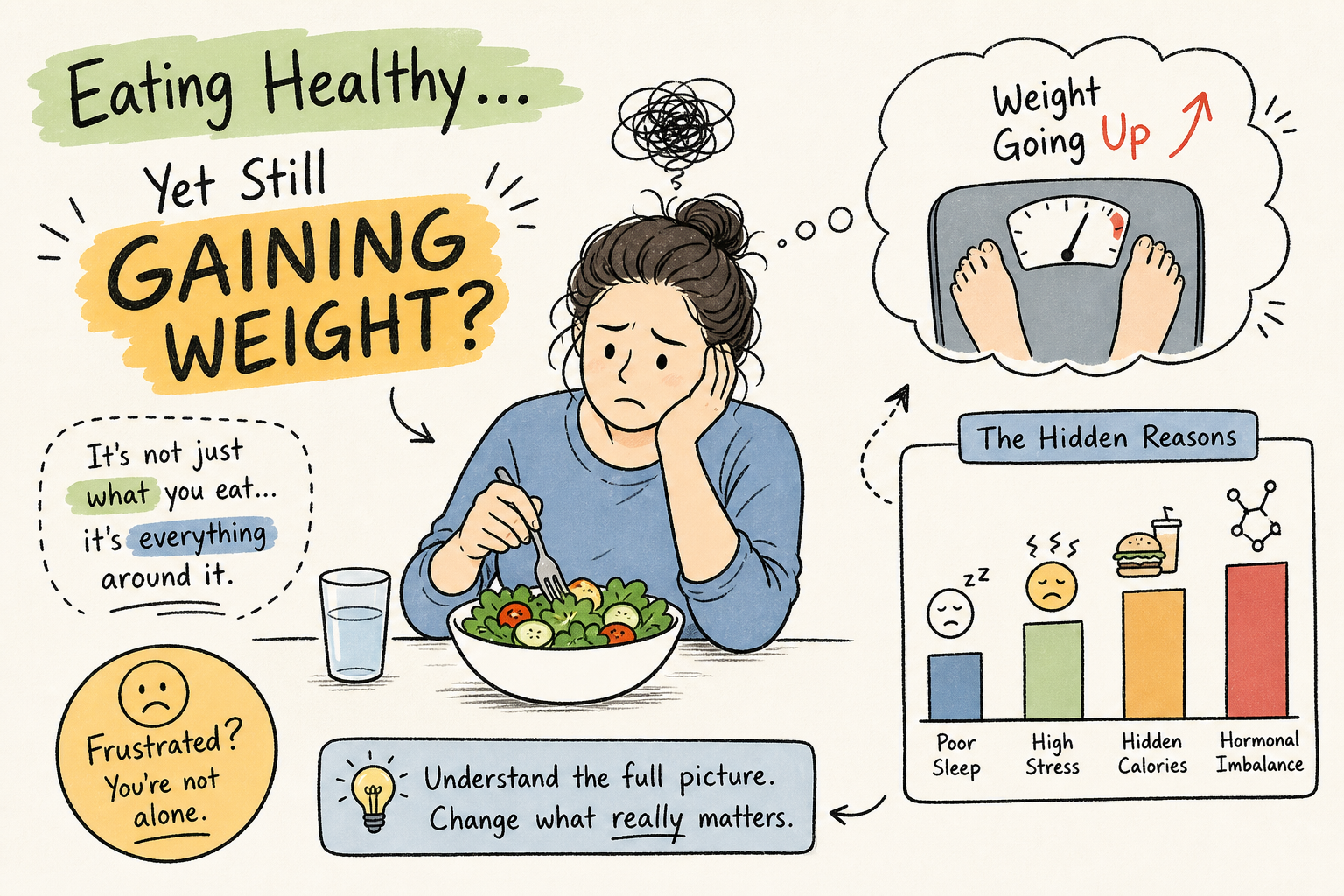
If you’ve been asking yourself, “why am I gaining weight eating healthy foods?”, you’re not imagining things, and you’re far from alone. You’ve swapped fast food for grilled chicken. You’re eating salads, drinking smoothies, and adding avocado to everything. The drive-through hasn’t seen you in months. And yet, the scale keeps climbing. At Activrr, this is one of the most consistent patterns we see with new clients: people eating genuinely nutritious food but unknowingly working against their own goals at the same time.
The frustration is real, and it makes sense. You’ve done what every wellness article told you to do. The problem isn’t your effort or your willpower. It’s that “eating healthy” and “eating correctly for your body and goals” are not the same thing. The gap between those two ideas is where unexplained weight gain lives. This article walks through the six most common reasons it happens, and what you can do about each one.
1. Why Am I Gaining Weight Eating Healthy Foods? Hidden Calories and Portions
Nutrient-dense does not mean low-calorie. Some of the cleanest foods on the planet are also extremely calorie-dense, and small servings stack up faster than most people expect. This is one of the most common hidden drivers of weight gain on a genuinely healthy diet, and it’s where hidden calories in healthy foods do the most damage.
Why nuts, avocado, and olive oil add up faster than you think
One ounce of almonds delivers around 164 calories. Half an avocado adds another 120 calories. A single tablespoon of olive oil contributes about 119 calories. These are not junk food numbers; these are the numbers from foods most nutritionists actively recommend. A “healthy snack plate” with a small handful of almonds, some avocado slices, and a light drizzle of olive oil can quietly carry 400 to 500 calories before you’ve added anything else to it.
The smoothie and granola trap
A smoothie built from banana, frozen berries, Greek yogurt, almond butter, oats, and almond milk can easily hit 500 to 600 calories. A half-cup serving of granola typically lands between 200 and 300 calories, and almost nobody measures a half cup without a scale. Neither of these foods is bad. The serving size problem is what creates the surplus, not the ingredients themselves.
What portion distortion looks like in practice
Dietary recall studies have consistently found that people underestimate their calorie intake, commonly by a wide margin, with the largest errors occurring around calorie-dense whole foods like nuts, oils, and avocado. Your brain is genuinely not wired to estimate the calorie load of a handful of cashews accurately. A full day of clean eating with consistently large portions of calorie-dense foods can generate a meaningful surplus without a single processed ingredient touching your plate. Portion control and mindful eating aren’t about restriction; they’re about accuracy.
2. How your macro ratios are shaping your results
Two people can eat identical “healthy” foods and get completely different outcomes based on the ratio of protein, fat, and carbohydrates on their plates. Food quality matters, but macro structure determines how your body uses what you give it. Macro ratio is often the overlooked variable that explains why a clean diet stops producing results.
Why protein is the most skipped macro
Protein is the most satiating macronutrient and carries the highest thermic effect, meaning your body burns more energy digesting it than it does digesting fat or carbohydrates. Many people eating clean tend to under-eat protein while over-eating healthy fats and complex carbs, a common pattern observed in nutrition coaching practice. This creates a calorie surplus without the fullness signals that protein reliably triggers. A commonly used coaching benchmark, and one aligned with many sports nutrition guidelines, is 0.7 to 1 gram of protein per pound of body weight per day. Most people on a standard “healthy” diet fall well short of that range.
The problem with a fat-heavy clean diet
Avocado, olive oil, nuts, salmon, and seeds are legitimately excellent foods. But fat carries 9 calories per gram compared to 4 calories per gram for both protein and carbohydrates. A plate tilted heavily toward healthy fats, even one with zero processed ingredients, can consistently generate a calorie surplus. The math isn’t an indictment of fat quality; it’s a case for proportion. When the majority of your calories come from fat sources, even high-quality ones, the numbers work against fat loss.
3. What stress and sleep are doing to your weight
Chronic stress and inadequate sleep are among the most commonly underestimated biological forces driving unexplained weight gain. This isn’t about mindset. These are measurable physiological changes that alter how your body stores fat and how much you eat the next day.
How cortisol turns stress into stored fat
When cortisol is chronically elevated, your body shifts into a fat-storage mode, with visceral fat (the fat around your abdomen) being particularly responsive. Cortisol activates fat-cell formation and enlargement in that region, raises blood glucose, contributes to insulin resistance, and triggers cravings for calorie-dense, carbohydrate-heavy foods by disrupting the brain’s reward and blood-sugar regulation systems. Chronic stress isn’t only emotional. Under-eating, overtraining, poor sleep, and work pressure all elevate cortisol just as effectively as psychological anxiety does. A consistently perfect diet cannot fully override a high-cortisol hormonal environment.
What sleep deprivation does to your hunger hormones
A landmark study by Spiegel and Van Cauter found that sleeping 5 hours versus 8 hours was associated with approximately 15 percent lower leptin (your satiety hormone) and nearly 15 percent higher ghrelin (your hunger hormone). This hormonal shift creates a biological pull toward eating more the following day, operating well below the level of conscious awareness. A meta-analysis published in Sleep Medicine Reviews suggests short sleep is linked to consuming an average of around 300 extra calories per day. That’s not a small number. Over the course of a week, that’s more than an extra day’s worth of food layered on top of what you planned to eat.
4. When your body itself is the obstacle
Sometimes the issue isn’t what you’re eating or how much stress you’re carrying. It’s a medical condition or medication working directly against your efforts. This is one of the most common blind spots because it requires looking beyond food and behavior entirely.
Why Am I Gaining Weight Eating Healthy? Thyroid Dysfunction, PCOS, and Insulin Resistance
Hypothyroidism slows your metabolism and can cause unexplained weight gain even on a calorie-controlled diet. PCOS drives insulin resistance and hormonal fat storage, particularly around the midsection. Insulin resistance itself causes the body to store more of what you eat as fat regardless of food quality, because cells aren’t responding properly to insulin’s signals. If you suspect any of these conditions, an initial blood panel typically includes TSH and free T4 for thyroid function, and total and free testosterone along with DHEAS as part of a broader hormonal workup for PCOS, which also involves clinical criteria like menstrual history and may include pelvic ultrasound. Fasting glucose, fasting insulin, and HbA1c round out an insulin resistance screen. These aren’t exotic tests; most primary care providers order them routinely.
How common medications silently add pounds
Corticosteroids like prednisone, certain antidepressants including mirtazapine, paroxetine, and amitriptyline, antipsychotics, beta-blockers, and some diabetes medications are all associated with clinically documented weight gain. The range varies considerably by drug, dose, and duration: beta-blockers may contribute a modest 2 to 5 pounds, while corticosteroids and antipsychotics have been associated with more substantial gains in some patients, sometimes exceeding 10 percent of body weight in longer-term use. If you started a new medication around the same time your weight changed, that connection is worth raising with your prescribing physician.
Signs it’s time to get tested
A few signals worth taking seriously: unexplained fatigue alongside weight gain, weight accumulating specifically around the abdomen or face, irregular menstrual cycles, or weight gain that started clearly in sync with a new medication. These aren’t reasons for alarm; they’re information. Getting the right tests means you stop guessing and start working with your actual biology.
5. Is it actual fat or just water retention?
Not every number on the scale represents fat. Many people experience genuine frustration over weight fluctuations that are primarily fluid shifts, not fat gain. Learning to read what the scale is actually telling you prevents a lot of unnecessary panic and course-correcting.
Short-term signs that point to fluid, not fat
If your weight jumps 2 to 4 pounds within a day or two, that’s almost certainly water, not fat. The traditional approximation used in nutrition practice is that adding one pound of fat requires roughly a 3,500-calorie surplus, meaning your body physically cannot accumulate 4 pounds of actual fat overnight, though individual metabolic variation means exact figures differ. Other signs of fluid retention include puffiness in the hands, feet, face, or ankles; bloating that shifts or resolves by time of day; and weight that returns to its previous number within 24 to 48 hours. Common triggers include high-sodium meals, a larger carbohydrate day, travel, and hormonal cycle fluctuations.
How to read your weight trends accurately
Weigh yourself at the same time each morning, after using the bathroom and before eating or drinking anything. Then look at the trend across 7 to 10 days rather than reacting to individual numbers. A number bouncing up and down within a 2 to 3 pound range is almost always fluid. A trend line that climbs consistently over two to three weeks is the signal worth paying attention to. Daily scale noise tells you almost nothing useful on its own.
6. Why Am I Still Gaining Weight Eating Healthy Foods? Here’s How to Find Your Specific Answer
At this point, you know there are multiple possible reasons why someone gaining weight while eating healthy might not be seeing the results they expect. The next problem is figuring out which reason is yours. That’s where most generic nutrition advice breaks down completely.
Why generic advice keeps you stuck
Most clean eating guides treat everyone the same. But one person’s weight gain comes from a macro imbalance, another person’s comes from elevated cortisol and poor sleep, and a third person needs thyroid testing before any dietary adjustment will move the needle. The fix has to match the actual cause. A calorie-tracking app can’t determine whether your issue is hormonal. A clean eating plan doesn’t account for the fact that your medication changed three months ago. Generic tools are useful for general awareness, but they can’t diagnose a personalized problem.
What a personalized nutrition analysis actually does
Activrr’s personalized nutrition analysis takes a different approach. Instead of handing you a meal plan based on your age and a weight loss goal, it reviews your actual food intake, macro ratios, lifestyle patterns, and health history together to identify the specific reason your body isn’t responding. This is the difference between knowing the six possible explanations for your weight gain and knowing which one applies to you. It skips months of trial-and-error and gives you a starting point built around your body, not a template. Here’s what that process covers:
- Macro ratio review based on your actual current intake
- Assessment of lifestyle factors including sleep, stress, and activity patterns
- Guidance on whether medical testing is a useful next step for your specific situation
- A corrective nutrition plan built around your identified root cause
The bottom line
If you keep asking “why am I gaining weight eating healthy foods,” the answer is almost never a single cause, and it’s never a character flaw. The culprit could be hidden calories in healthy foods, a macro ratio tilted too far toward fat, chronic cortisol or sleep disruption altering your hormonal environment, an underlying condition like hypothyroidism or insulin resistance, medication side effects, or fluid shifts being misread as fat gain. Once the root cause is identified, the fix becomes clear. Most people never reach that point because they keep applying generic solutions to a specific problem.
If you’re ready to move past the guesswork, Activrr’s personalized nutrition analysis is built specifically for people who are doing the right things and still not seeing results. Portion control and mindful eating matter, but they work best when they’re calibrated to your body. You’ve already done the hard part by eating well. Now it’s time to eat right for your body.