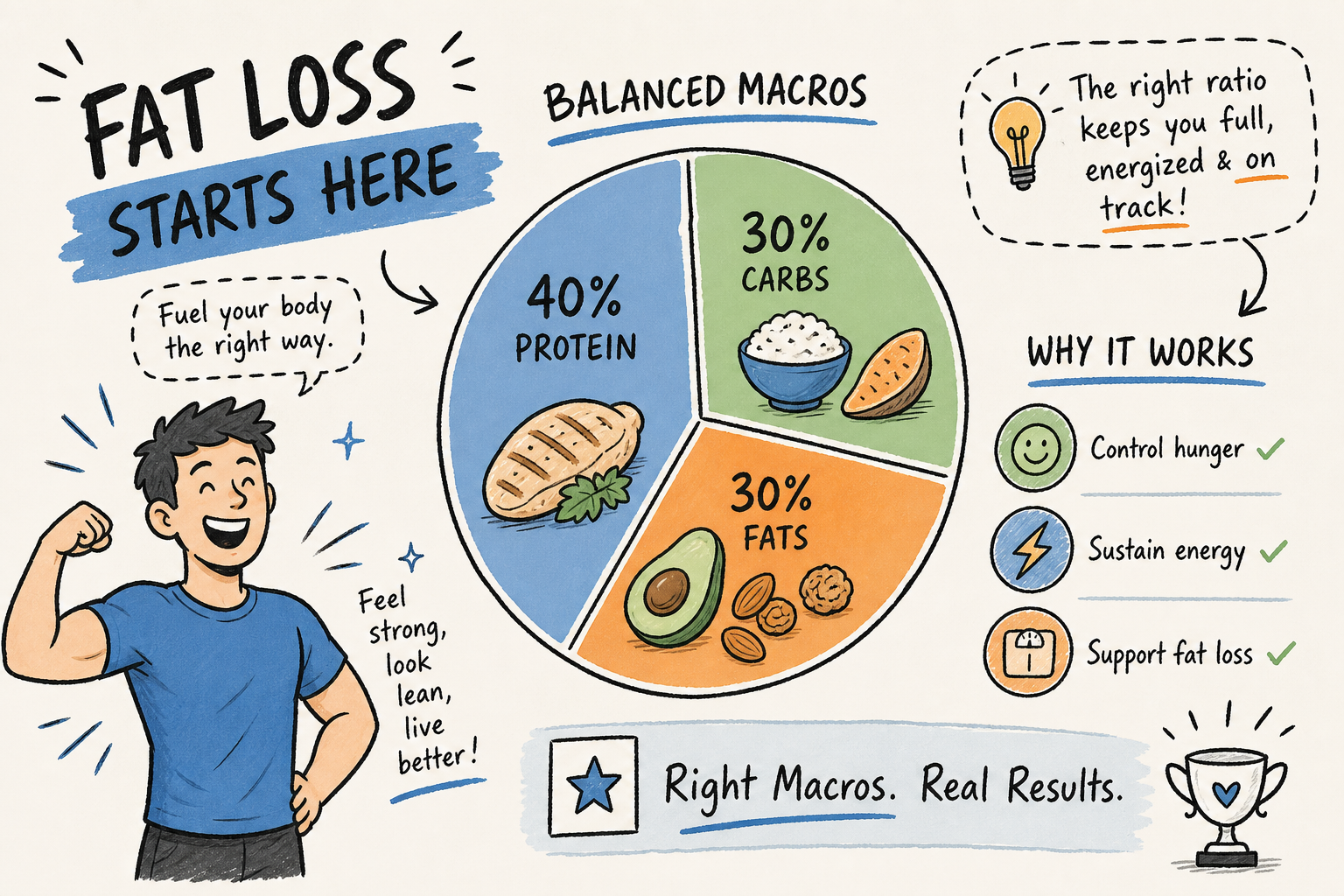
Getting your macros for fat loss right doesn’t require a nutrition degree or hours of spreadsheet work. It requires understanding two things: eat less than you burn, and eat enough protein to keep your muscle. Everything else, the percentages, the ratios, the timing, is detail work that shapes how sustainable and effective your cut feels day to day.
This guide walks you through the complete process: calculating your maintenance calories, picking a macronutrient split that fits your life, converting percentages into actual grams, seeing what those numbers look like on a plate, and adjusting when progress stalls. By the end, you’ll have a personalized framework you can start using this week.
Macros for fat loss explained: what actually drives results
Why a calorie deficit drives fat loss
No macro ratio, no matter how cleverly designed, overrides energy balance. Fat loss happens when your body burns more calories than it takes in, period. Your deficit determines whether you lose fat; your macro split determines how well you feel, train, and hold onto muscle while doing it. Treat the deficit as the non-negotiable foundation and the macro breakdown as the tool you use to make that deficit liveable.
What protein, carbs, and fats do during a cut
Each macronutrient plays a distinct role during a fat-loss phase. Protein preserves lean muscle mass and keeps hunger in check by triggering satiety hormones, this is why high protein is the one consistent recommendation across virtually every evidence-based fat-loss protocol.
Carbohydrates fuel hard training sessions and replenish glycogen, so dropping them too low tanks your performance before it tanks your waistline. Dietary fat supports hormone production, including testosterone and estrogen, and allows your body to absorb fat-soluble vitamins A, D, E, and K. Flexible dieting, sometimes called IIFYM (If It Fits Your Macros), works because it uses all three levers instead of eliminating any one of them.
IIFYM with smart guardrails
IIFYM simply means hitting your daily protein, carbohydrate, and fat targets regardless of which specific foods you eat. It’s a practical, non-dogmatic approach, and some research comparing flexible dieting to more rigid meal plans suggests similar fat-loss outcomes when total calories and protein are controlled. The mistake people make is treating it as a junk-food loophole. The guardrails matter: 25 to 38 grams of fiber daily, plenty of produce, lean proteins, and minimally processed whole foods as your base. You can fit the occasional treat into your numbers, but the majority of your intake should support gut health, micronutrient needs, and stable energy.
Where Activrr fits your plan
If you’d rather skip the manual math, Activrr builds your macro targets from your actual stats, age, weight, height, activity level, and goals. As a platform feature, it adjusts your targets as your weight and behavior data change over time, so your numbers stay accurate rather than drifting into obsolescence three months in.
Find your number: maintenance calories and a smart deficit
How to estimate TDEE in minutes
Start with the Mifflin-St Jeor equation to estimate your basal metabolic rate (BMR), the calories your body burns at complete rest. For men: (10 × weight in kg) + (6.25 × height in cm) − (5 × age) + 5. For women: (10 × weight in kg) + (6.25 × height in cm) − (5 × age) − 161. Then multiply your BMR by an activity factor: 1.2 for sedentary, 1.375 for lightly active, 1.55 for moderately active, and 1.725 for very active. If you prefer an automated option, a maintenance calorie calculator can speed the estimate.
As a worked example: a 35-year-old woman, 165 cm, 75 kg, moderately active gets a BMR of roughly 1,445 kcal and a TDEE of approximately 2,239 kcal. That’s your maintenance baseline before any deficit is applied. For more on how many calories maintain weight and practical considerations, see this guide: calories to maintain weight.
How big should your deficit be?
A deficit of 300 to 500 calories per day is the sweet spot for most people. That range targets 0.5 to 1 percent of body weight lost per week, fast enough to see real progress, but slow enough to protect muscle and training performance. Eating at 80 to 90 percent of your TDEE is another clean way to frame it. Using the example above, that’s a daily target somewhere between 1,750 and 1,950 calories.
When to adjust calories during your cut
Reassess every two to four weeks using your weekly average weight, not a single morning weigh-in. If the scale hasn’t moved in two consecutive weeks and you’ve been consistent, drop intake by 100 to 150 calories. If you’re losing faster than one percent of body weight per week and your training is suffering, add 100 to 200 calories back. Always check adherence first, the most common reason for stalled progress is underreporting, not a broken metabolism.
Pick a macro ratio for fat loss that matches your life
Set protein first with grams per kg or lb
Protein is the anchor of any fat-loss macro plan. The evidence-based target for most people is 1.6 to 2.2 grams per kilogram of body weight, or 0.7 to 1.0 grams per pound. A 2018 meta-analysis by Morton et al. identified 1.62 g/kg as the approximate threshold above which additional protein produced no further gains in lean mass, making it a reliable floor during a cut. If you’re lean, training hard, or in an aggressive deficit, some practical guides suggest pushing toward 2.3 to 3.1 g/kg, though evidence for the higher end of that range is less conclusive, treat it as a ceiling rather than a target. If you carry more body fat, set protein based on your goal body weight rather than your current weight to avoid inflating the target unnecessarily.
Activity-based macro templates that work
Once protein is locked in, distribute the remaining calories between carbs and fat based on your training schedule. A balanced starting point for most people is 40 percent carbs, 30 percent protein, and 30 percent fat.
- Lower-activity individuals do well with a slightly higher protein proportion: roughly 30 to 40 percent protein, 30 to 40 percent carbs, and 20 to 30 percent fat.
- Higher-activity individuals, especially those lifting four or more days per week, benefit from a carb-forward setup: 35 to 50 percent carbs, 25 to 35 percent protein, and 20 to 30 percent fat.
Keep dietary fat at or above 20 percent regardless of training volume to protect hormonal health.
Nutrition guardrails you should not break
Whatever split you choose, two rules hold firm. First, keep saturated fat below 10 percent of total calories, the current U.S. Dietary Guidelines recommendation, with overall fat staying in the 20 to 35 percent range to cover essential fatty acids and fat-soluble vitamins. Second, hit your fiber target: 25 grams per day for women and 38 grams for men. Fiber keeps digestion running, supports gut bacteria, and extends satiety between meals.
Do the math: convert your split into grams you can track
Step 1: lock protein grams from body or goal weight
Take your body weight, or goal weight if your body fat is high, and multiply by your chosen protein target. A 75 kg person aiming for 1.8 g/kg needs 135 grams of protein per day. Multiply that by 4 calories per gram and you get 540 calories from protein. That leaves the remaining calories to divide between carbs and fat.
Step 2: set fat grams, then fill carbs with the rest
With a 2,000-calorie target and 540 calories already allocated to protein, you have 1,460 calories remaining to split between fat and carbs. Set fat at 25 percent of total calories: 2,000 × 0.25 = 500 calories from fat, which is 500 ÷ 9 = 56 grams of fat. The remaining 960 calories go to carbs: 960 ÷ 4 = 240 grams. Your final daily targets are 135g protein, 240g carbs, and 56g fat.
Sample macro breakdowns at 1,500, 2,000, and 2,500 kcal
Here’s how those numbers translate into food across three common calorie levels. Note that gram targets are rounded for practicality and are approximate illustrations rather than precise prescriptions:
| Daily target | Protein | Carbs | Fat | Sample meal |
|---|---|---|---|---|
| 1,500 kcal | ~130g | ~150g | ~42g | Egg whites + avocado + banana at breakfast; chicken breast, sweet potato, and broccoli at dinner |
| 2,000 kcal | ~150g | ~215g | ~55g | Greek yogurt + oats + berries at breakfast; salmon, quinoa, and roasted vegetables at dinner; cottage cheese as a snack |
| 2,500 kcal | ~185g | ~270g | ~68g | Eggs + toast + fruit + nut butter at breakfast; turkey bowl with rice, beans, and salsa at dinner; trail mix and a protein shake as snacks |
Each meal follows the same scaffold: a lean protein source, a quality carbohydrate, a vegetable, and a small fat source. Scaling between calorie levels is as simple as increasing portion sizes, not reinventing the menu.
Use a macro calculator or let Activrr build it
You can run through the math above manually, or you can use a structured macro calculator that inputs your stats and outputs daily gram targets. Activrr takes this a step further by suggesting specific meal ideas that match your food preferences and schedule. As your weight changes, the platform recalculates and updates your targets so you’re always working from numbers that reflect where you are now, not where you started.
Adapt day to day: training days, rest days, and carb cycling
Strength or HIIT days: raise carbs, lower fat
Hard training sessions run primarily on glycogen, so the days you lift heavy or push interval work are the days to prioritize carbohydrates. A simple carb-cycling approach bumps carbs on training days, by around 30 to 50 grams as a rough starting point, scaled to your body size and training volume, while reducing fat by a proportional amount to keep total calories stable. Protein stays the same every day. Place those extra carbs in the two to three hours before training and in your post-workout meal.
Rest or light activity days: moderate carbs, slightly higher fat
On days with no structured training or only easy walking, glycogen demand drops significantly. Shifting a portion of your carb calories, roughly 200 to 300 calories as an illustrative example, over to fat can better match your fuel source to your activity level. In practice, that might mean replacing a serving of rice or oats with a larger avocado portion or a tablespoon of olive oil. The right amount will depend on your total calorie target and body size, so treat the number as a starting point and adjust based on energy and hunger signals. Total intake stays similar; only the macro distribution shifts.
How to adjust macros for fat loss mid-cut
Make small, data-driven adjustments rather than dramatic overhauls. When progress stalls, tweak carbs or fat by 5 to 10 percent while keeping protein constant. Base every change on at least one week of consistent data: scale trends, energy levels, training performance, and hunger signals all carry useful information. A single bad weigh-in after a salty meal or a poor night’s sleep tells you nothing about actual fat loss.
Stay out of the traps: common macro mistakes and easy fixes
Percentage-only thinking that undercuts protein
Setting protein as a percentage of calories works fine at moderate calorie intakes, but it breaks down at the extremes. At 1,400 calories, 30 percent protein is only 105 grams, below the 1.6 g/kg threshold for a 70 kg person. At high body weights, the same percentage overshoots what’s useful. Always anchor protein to body weight in grams per kilogram or grams per pound first, then build percentages around that fixed number.
Ignoring fiber, food quality, and liquid calories
Flexible dieting works when the majority of your intake comes from whole, minimally processed food. Alcohol is particularly disruptive: it provides 7 calories per gram, displaces protein and carbs without adding satiety, and impairs recovery. Sugary drinks add calories with no volume or chewing that would signal fullness. Track them or cut them, don’t let them silently erode your deficit.
Overcorrecting and never recalculating
Two patterns that consistently derail a cut: slashing calories dramatically after a stall (which invites binge-restrict cycles), and never updating targets after losing weight. Every 5 to 10 pounds lost, your TDEE drops slightly because you’re moving a lighter body. Recalculate every two to four weeks and make modest 100 to 200 calorie adjustments rather than swinging to aggressive extremes.
Make it sustainable with Activrr
Sustainable fat loss requires more than a spreadsheet. Stress raises cortisol, which disrupts sleep and amplifies cravings, factors that no macro plan addresses on its own. That’s why Activrr combines nutrition guidance with stress and recovery tools, including movement sessions designed to complement your eating strategy, because managing the lifestyle factors around your diet matters as much as the numbers inside it. The platform tracks your weekly trends, prompts small data-informed adjustments, and keeps your plan evolving alongside your body rather than leaving you stuck with a static set of targets from month one.
If you’re ready to stop guessing and start working with a plan built around counting macros for fat loss in a way that fits your specific body, goals, and schedule, Activrr is the clearest next step. Your macros should work for you, not the other way around.